

PPWR and Green Claims 2026: what's changing for businesses
You’re about to launch a new product. The formula is ready, the packaging format has been chosen, and you’d like to label the packaging Sustainable Packaging. Until yesterday, this was a marketing choice. Starting in 2026, it’s a claim you’ll need to be able to prove — and the packaging itself has become a regulated product.
This year brings two regulatory developments that, taken together, change the rules for anyone placing a dietary supplement or food product on the European market. These are not minor updates. They are two paradigm shifts occurring just a few weeks apart, affecting two distinct aspects of the same product: what’s inside the package and what you can write on it.
Two Regulations, Two Plans
The first is the PPWR, the Packaging and Packaging Waste Regulation — formally Regulation (EU) 2025/40. It entered into force on February 11, 2025, and becomes applicable on August 12, 2026. It covers packaging: how it is made, what it is made of, how much it weighs, and whether it is recyclable. It is not a directive to be transposed by individual countries; it is a regulation, directly applicable in all 27 Member States under the same rules.
The second is the decree that everyone calls Green Claims: Legislative Decree 30/2026, which transposes Directive (EU) 2024/825 into Italian law regarding consumer empowerment for the green transition. The new rules take effect on September 27, 2026. The focus here is not on packaging, but on communication: what a company can claim about a product’s sustainability, and under what conditions.
One controls the situation. The other controls what you say about it. And it’s where the two meet that the game is decided.


What’s Changing with Packaging
The PPWR transforms packaging into a fully regulated product. The underlying principle is simple: all packaging placed on the market must be designed so that it does not become waste. This principle gives rise to a phased timeline, with the most stringent deadlines set for later — recyclability, minimum recycled content, and limits on empty space take effect in 2030, while harmonized European labeling takes effect in 2028. However, three requirements take effect immediately, on August 12, 2026.
The first concerns substances. As of that date, packaging intended to come into contact with food may no longer be placed on the market if it contains PFAS—the so-called «forever» chemicals — above very low thresholds: 25 parts per billion for PFAS measured by targeted analysis, and 250 parts per billion for their total. The same regulation also sets a limit of 100 mg/kg for the sum of lead, cadmium, mercury, and hexavalent chromium. To help companies verify compliance, the Commission has published interpretive guidance that proposes a phased approach based on the measurement of total fluorine, organic fluorine, and oxidizable precursors.
The second requirement is administrative: an EU Declaration of Conformity is required for each type of packaging, in accordance with Article 39 and Annex VIII of the regulation. The third requirement concerns registration with extended producer responsibility systems in each Member State where the packaged product is placed on the market.
There is also an aspect that redefines responsibilities throughout the supply chain. Whoever places the product on the market under their own brand assumes the role of manufacturer for the purposes of the regulation — even when production and packaging are outsourced to a third party. The technical documentation and the EU Declaration of Conformity therefore remain the responsibility of the brand owner. The manufacturing partner, for its part, is required to provide the technical data, material specifications, and evidence necessary to support that declaration. Article 16 of the regulation also explicitly states the obligation to request the necessary information and documentation from suppliers.
What’s Changing in Terms of what You Can Report
Legislative Decree No. 30 of 2026 addresses a different but complementary area . It amends the Consumer Code and classifies as an unfair commercial practice what, until yesterday, was subject to case-by-case assessment: generic and unsubstantiated environmental claims.
The first prohibition concerns generic assertions. Terms such as «ecological», «green», or «environmentally friendly» may no longer appear on a product without the backing of recognized and demonstrated environmental excellence. And be aware of a detail that is often overlooked: using the adjective to refer to the product as a whole remains prohibited even when environmental excellence has been proven for a single aspect.
The second point concerns sustainability labels. Logos and seals that imply environmental characteristics may not be displayed unless they are based on a recognized certification system or a ruling by a public authority. A label that a company has designed on its own, so to speak, is no longer valid.
The third concerns climate neutrality: declaring oneself “carbon neutral” by relying solely on the purchase of carbon offsets, without a genuine plan to reduce emissions, falls within the scope of prohibited practices. The AGCM is responsible for enforcement, with a system of penalties that, in the most serious cases, can amount to a significant portion of a company’s revenue.


The Missing Rule
There is one point that needs to be made here—one that is rarely mentioned but explains the context in which we operate better than anything else. Directive 2024/825 stipulates that an environmental claim must be true, verifiable, up-to-date, and not generic. However, it does not specify how this is to be demonstrated: it establishes qualitative requirements, not mandatory measurement and verification methodologies.
That task was to be addressed by a second, much more technical and stringent text: the proposal for a Directive on the substantiation of explicit environmental claims, known as the Green Claims Directive, presented by the Commission in March 2023. It provided for prior verification by independent bodies, life-cycle assessments, and validation procedures for private environmental labeling systems.
That text is currently stalled. Parliament had adopted its position in March 2024 and the Council had adopted a general approach the following June, but the trilogue negotiations have stalled: the final trilogue in June 2025 was canceled, and negotiations have been suspended ever since. The reasons were clear — a proposal deemed too complex and costly, with disproportionate administrative burdens and an unresolved issue regarding micro-enterprises, which account for approximately 96% of the EU’s business sector. Formally, the proposal has not been withdrawn: it remains “under review” in the Commission’s 2026 work program.
The practical consequence is paradoxical, and it’s worth understanding it clearly. Starting September 27, companies will face a clear ban, but they won’t have a shared technical standard for proving that a claim is valid. The scope of what cannot be said is clear-cut; the method for proving what one wishes to say is not.
It is precisely in this gap that third-party certification takes on greater significance. In the absence of mandatory metrics, a certification issued by an independent and recognized body becomes the most reliable tool available to a company to back up its claims—not because the law requires it, but because it is evidence that no one can dispute as self-serving. Those who have already built their positioning on certified claims find themselves — without having changed a thing — with an advantage that was previously implicit and is now explicit.
The point where the Two Meet
That’s why the two regulations must be read together. The PPWR defines what constitutes packaging; the Green Claims Decree sets out the conditions under which you can make such claims. Starting in 2026, writing «sustainable packaging» or «100% recyclable» on a Stick Pack or a Doypack will require two things: that the packaging actually meets the technical requirements, and that you have the documentation to prove it.
In short, an environmental claim is no longer just a phrase. It’s the tip of the iceberg. And that iceberg is built up along the entire supply chain: from material suppliers to the packaging partner, all the way to the brand that signs the declaration. Every link in the chain must provide its share of evidence.
What does this mean for Product Developers?
For a brand owner or buyer in the industry, the operational message is clear. The choice of packaging format is no longer just a matter of positioning; it has also become a compliance decision. A material, a barrier structure, or a coating are no longer evaluated solely for product stability, ease of use, and shelf appeal; recyclability, the absence of restricted substances, and document-based traceability now come into play.
There is also an operational aspect that should be addressed before the deadline. Compliance with the thresholds is not verified downstream, on the finished product; it is tracked throughout the supply chain. It is the material supplier who must document, through the Declaration of Conformity for food-contact materials, that the film, laminate, or coating complies with the limits. The packager collects this documentation, retains it, and makes it available to the party placing the product on the market under its own brand — which is the party required to sign the EU Declaration of Conformity as stipulated by the regulation.
In co-packing, this step occurs in two different scenarios, and it’s worth distinguishing between them. When we source the packaging material ourselves, verifying the compliance documentation is part of the supplier qualification process: no material enters production without the accompanying specifications and declarations. When, on the other hand, the client supplies the material, the documentation must be requested from the client’s source: packaging does not validate a material lacking supporting documentation, and processing it without such documentation would expose both parties to risk.
For those — like us — who operate under a Certified Food Safety Management System, none of this is new: supplier qualification, verification of specifications, and traceability of materials are already established practices that are verified through audits. The PPWR does not introduce a new requirement — it raises the bar in an area that manufacturers packaging for demanding brands already monitor. The difference is that, starting in August, that requirement becomes a condition for market access, no longer merely a matter of good industrial practice.
One detail worth clarifying — because it’s often overlooked—is that the ban does not apply to the packaging’s date of manufacture, but rather to the date it was placed on the market. The PPWR does not provide for any phase-out period. Products already on the market before August 12 may continue to circulate, but material sitting in inventory does not become usable simply because it was produced earlier. Contract packagers therefore have every reason to map out their materials in a timely manner and align their procurement: it is a matter of production continuity, even more so than compliance.
This is a task best done early on, during the development phase, rather than later on with a product that’s already been finalized. Redesigning packaging after the labels have been printed costs much more than designing it well from the start. And this is where a manufacturing partner who understands these constraints makes all the difference: in choosing the right material, in requesting the correct documentation from suppliers, and in building the documentation foundation on which the brand will base its claims.
For developers and manufacturers, the direction is clear. Sustainability expressed in words is giving way to sustainability demonstrated through documentation. This is not yet another constraint to endure: it is the arena in which products built with integrity will finally be able to distinguish themselves from those built on empty promises.
September 2026 Update: following the implementation of the PPWR, the Ministry of the Environment has issued guidelines, and the Commission has published FAQs regarding who qualifies as a Manufacturer and who qualifies as a Supplier. You can find them in our operational update.
If you’re developing a product and want to consider the packaging format in light of these constraints, please talk to us — the technical team at Encanto Nutraceutica.

Related Contents

Barrier Packaging: what actually protects a dietary supplement
Oxygen, light, and moisture degrade active ingredients before their expiration date. How materials and packaging act as barriers, and the issue of recyclability.

Sleep Supplements: the category consumers are evaluating
Sleep is the only category in which consumers evaluate the results using a number.

Packaging and Environmental Claims: Who is responsible for What
MASE has clarified the roles regarding PPWR: whoever applies the label is the manufacturer. The Green Claims regulations take effect on September 27. Here’s what to check now.
Vegan Supplements: why Certification matters more than Claim
There was a time, not many years ago, when the word "Vegan” on a label was enough to set a product apart. Today, that’s no longer the case — at least not on its own.

Private Label vs White Label
Private Label and White Label are often confused. The difference lies in who develops the formula — and this affects the timeline, costs, and exclusivity of your product.
Stick Packs: When the Packaging Is Already Half the Product
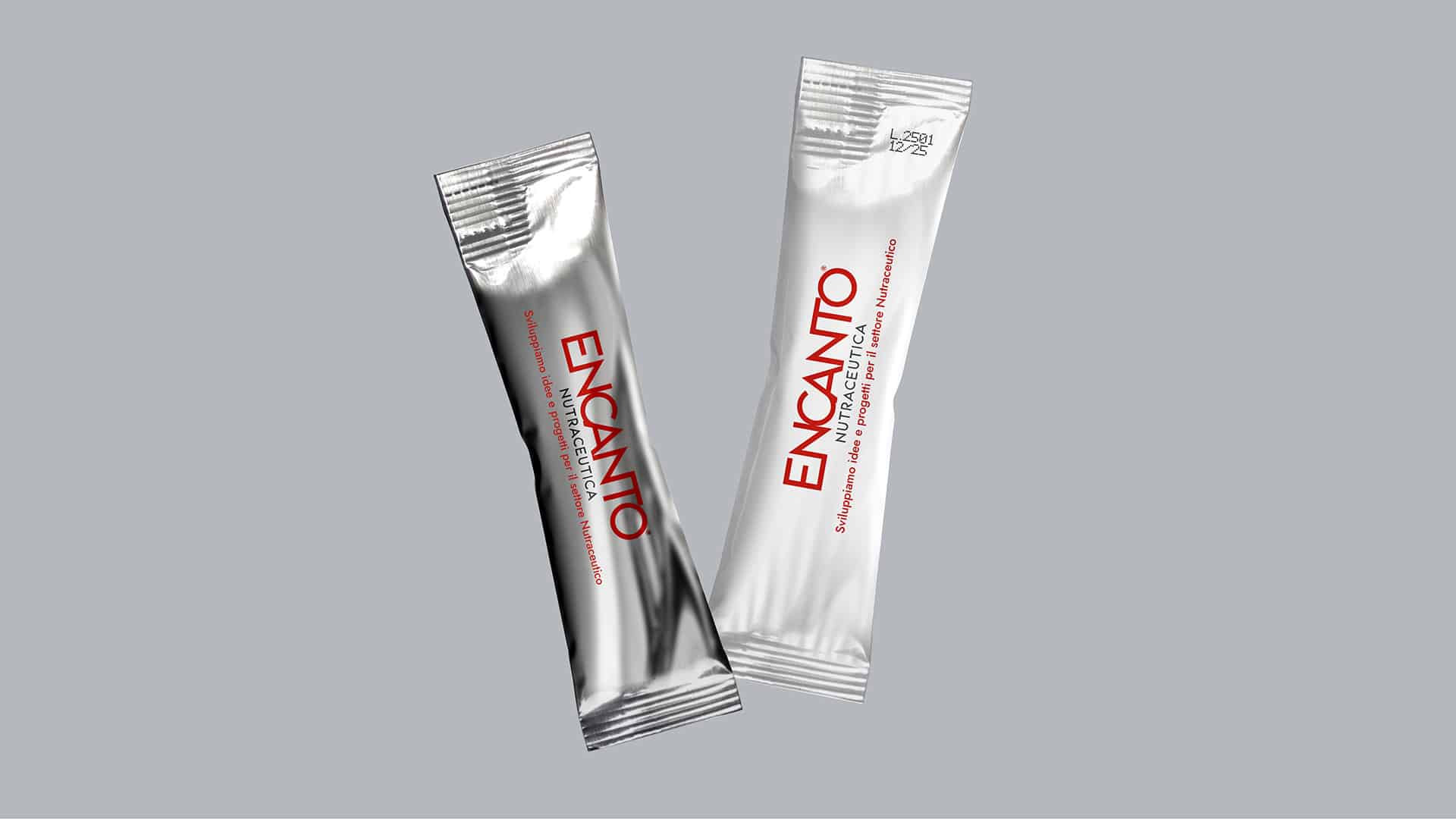
The Stick Pack is the fastest-growing nutraceutical format. Portability, single-serve portions, branding, and compliance: why more and more brand owners are choosing it to launch supplements.

Supplementary animal feeds are serious products. We treat them as such.
The packaging of supplements and complementary feed for pets takes place in a dedicated department, in compliance with EC Reg. 183/2005.

Menopause and Nutraceuticals: functional ingredients for each phase.
Menopause is a physiological transition, not a disease. Marine Collagen, Omega-7, Magnesium, Ashwagandha: the nutraceutical ingredients with the strongest evidence for each symptom.

Adaptogens: the plants that help the body respond to stress
Adaptogens are botanicals that support psychophysical resilience by modulating the HPA axis. Ashwagandha, Gastrodia elata, Rhodiola: mechanisms, evidence, and applications in formulation.

Balsamic Vinegar of Modena PGI: what it means to package it
PGI is not a decorative label. For Balsamic Vinegar of Modena, every step-including packaging-meets precise rules and verifiable controls